

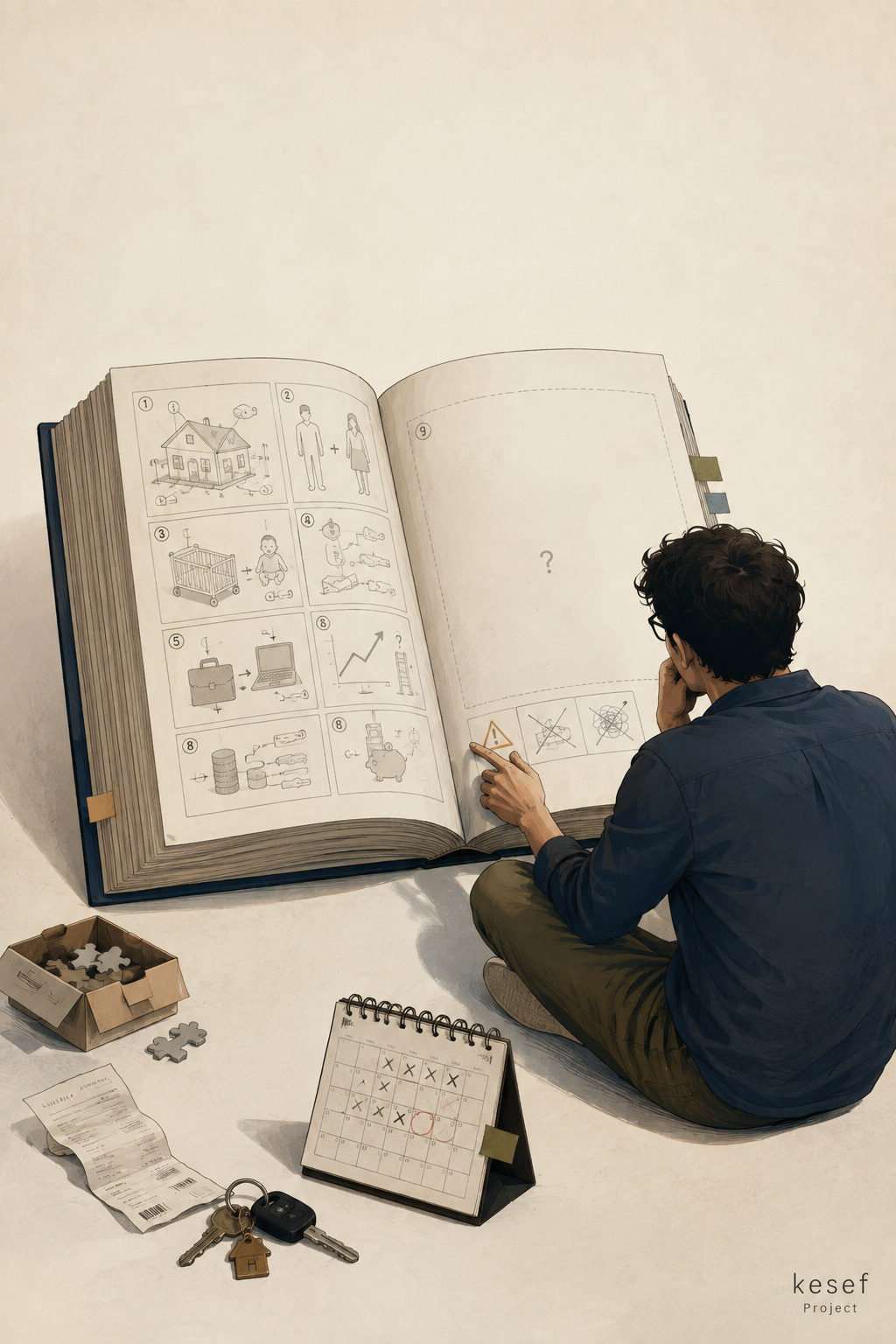

There comes an age when you begin to notice that life seems to come with an invisible checklist.
A home. A partner. Children. A career that means something. Savings. A purpose. And, if possible, a convincing answer when someone asks what exactly you are doing with your life.
Nobody hands you that list at a formal meeting. There is no folder labeled “Official Manual for Being an Adult.” The instructions appear gradually, in family conversations, questions from acquaintances, comparisons, and that feeling that maybe you have fallen behind while everyone else received directions that somehow got lost in the mail.
For a long time, the message was pretty clear: by a certain age, you should have this; a few years later, you should have achieved that; and eventually, you should know who you are and where you are going.
Then social media arrived with an updated version of the manual.
Apparently, a much friendlier one.
Now you don't need to have your entire life figured out. Excellent. But you do need to heal, find your purpose, work on yourself, leave your comfort zone, set boundaries, become independent, turn your crises into opportunities, and, of course, be happy.
Preferably while waking up at five in the morning, journaling, meditating, reading twenty pages of a book, and starting the day with warm lemon water.
Because apparently, even resting now requires a productivity routine.
What is curious is that we spend years trying to escape the expectations others have placed on our lives, and once we manage to get some distance from them, we go looking for another set of instructions. The words change, but the pressure remains. We used to be told that we should have more; now we are told that we should become more.
Success has turned into purpose, independence into emotional self-sufficiency, and gratitude into a warning against settling. Simply living is no longer enough. We also have to prove that we are evolving.
And so, a person can end up exhausted from trying to escape other people's demands while obediently following the demands of a newer version of themselves.
We changed the manual, but we're still looking for one.
Perhaps that is why I find the idea that nobody has absolutely everything figured out so liberating. Life doesn't work like an exam you hand in at thirty, forty, or fifty, only to receive a grade that says, “Excellent. You may now proceed to the next stage.”
How convenient would that be?
But no such ceremony exists. Someone can have a stable career and no idea what to do with the rest of their life. Another person can enjoy a wonderful family while facing serious financial difficulties. Some people have plenty of money and very little peace, while someone with much less has people who would show up at their door at two in the morning without asking questions.
Some people know exactly what they want. Others are still trying to decide what they are having for dinner tomorrow.
That is adulthood, too.
Now, admitting that nobody has all the answers does not mean we should stop examining our lives. There is a difference between recognizing that we are going through a difficult season and deciding that the season defines us permanently. One is accepting our limitations; the other is using uncertainty as an excuse to do nothing.
The problem begins when we turn every situation into evidence that we are doing something wrong. Happy with your job? Perhaps you should find something better. Comfortable in your home? Aim higher. Enjoying your life? Be careful—you might be stagnating. Feeling peaceful? Time to leave your comfort zone.
As though contentment were a silent illness we needed to catch early.
I don't believe in the opposite extreme, either, where every desire to grow is treated as an unhealthy obsession with achievement. There are times when we need to move. Sometimes comfort stops being rest and becomes stagnation. At other times, circumstances make it impossible to keep living the same way.
But we don't need a motivational quote about leaving our comfort zone to recognize that. Sometimes the situation simply isn't working anymore.
There are also practical limits that a positive attitude cannot erase. We have to live within our means, avoid spending money we don't have, and stop taking on responsibilities we cannot sustain. We cannot pretend indefinitely that our budget is something else.
That isn't mediocrity. It's reality.
And living within our means today doesn't mean tomorrow has to look exactly the same.
Being content is not the same as settling.
Something similar happens with another phrase we hear constantly: “Every crisis is an opportunity.”
Well, some are. Others are simply crises.
Some losses eventually transform us, some difficulties change our direction, and some painful seasons make more sense years later. We can look back and say, “Now I understand something I couldn't see then.” But that doesn't mean we had to call it an opportunity while we were suffering through it.
Some things simply hurt.
A loss may teach us something, but first it can break our hearts. An illness may change our priorities, but we don't have to be grateful that we became ill. Financial hardship may teach us to manage our resources better, but the electricity bill is still the electricity bill. It doesn't need to become a spiritual growth experience just to make it to the fifteenth.
The Bible doesn't require us to deny pain in order to find meaning in it, either. The Psalms are full of people who cry, ask questions, plead, and wait. Job lost things he did not deserve to lose. Jesus wept at Lazarus's death.
Biblical faith does not require us to pretend that something doesn't hurt.
The same is true of happiness. Saying that everything depends on our attitude sounds encouraging until we forget that some circumstances are beyond our control and were never our choice. We can enjoy one day and receive news the next morning that changes everything. We can celebrate an achievement while missing someone who is no longer here. We can finally reach something we wanted for years and discover that the satisfaction doesn't last forever.
That doesn't make happiness a lie. It means happiness is a human experience that changes.
For those of us who believe in God, peace and joy open a different conversation. Paul wrote about learning to be content both in abundance and in need (Philippians 4:11–13). He was not describing a life without problems, but a kind of stability that did not depend entirely on circumstances. Habakkuk expressed his trust in God even in the face of failed crops and disappearing livestock (Habakkuk 3:17–18).
None of this means a believer has to walk through life smiling as though nothing is happening. We can be sad and still have peace, worry and still trust, cry without giving up hope.
Faith does not require everything to be fine for us to keep going.
There is another instruction in the modern manual worth reconsidering: “Everything depends on you.”
There is some truth to it. Our decisions matter, as do our habits, our responses, and the boundaries we establish. What we do after making a mistake matters, too. But part of our lives will always remain beyond our control.
Other people's decisions affect us. Economic circumstances matter. There are illnesses, accidents, losses, and family situations we never chose. Doors close without asking our permission, and events happen that we cannot prevent, no matter how well we have done everything else.
Telling someone that everything depends on them can end up sending a different message: if things didn't work out, you simply didn't try hard enough.
That isn't true, either.
The Bible does not portray human beings as people who completely control their own paths. Proverbs 16:9 acknowledges that we make plans, but God directs our steps. Planning matters. Responsibility matters. Work matters. Having control over everything is something else entirely.
Perhaps part of growing up is learning to distinguish between what we are responsible for doing and what was never in our hands.
That distinction also helps us face one of the hardest expectations to abandon: the belief that doing the right thing guarantees a good outcome.
I work hard. I'm responsible. I treat people well. I make good decisions. Therefore, things should work out.
But life doesn't work like a vending machine where we insert obedience and receive favorable results.
Joseph was sold by his brothers. David did what was right and still had to flee for his life. Job lost things he had done nothing to deserve. Paul was imprisoned, and Jesus was rejected.
Faithfulness is not an insurance policy against adversity.
When we believe that doing everything right guarantees that everything will turn out right, difficulties do more than force us to face a problem. They also lead us to interrogate ourselves: “What did I do wrong?”
Sometimes the answer is: nothing. It simply happened.
This doesn't mean we should never examine our decisions. Some mistakes need to be acknowledged, and some consequences must be faced. But not every hardship proves that we made the wrong decision, just as not every success confirms that we acted correctly.
That is why I am increasingly unconvinced by the idea that growing up means finding a formula that works in every situation. Life demands something harder than memorizing instructions: discernment.
There are times to persist and times to rest. Occasions when we need to change and others when it is better to wait. Sometimes we must accept what we cannot alter; in other circumstances, we need to stand up for something that matters. We have to learn when what we have is enough, while also recognizing when what we call comfort is actually fear.
Depending on someone does not automatically make us weak. Being independent does not mean isolating ourselves. Wanting more is not always excessive ambition, just as being content does not mean giving up on growth.
We can be grateful for what we have and feel exhausted at the same time. We can deeply love someone and still need distance. We can achieve a goal we dreamed about for years and still feel lost on an ordinary Tuesday. None of these contradictions necessarily means we are living the wrong way.
Perhaps we don't need a perfect explanation for every stage of our lives or a new formula every time things stop working as we expected.
After all, life is still life. There will be good days and absurdly bad ones. Seasons when we move forward and others when all we can do is keep ourselves standing. Some doors will open, and others will close. There will be things we can change and others we will eventually have to let go.
For those of us who walk with God, perhaps the most important question is not whether we have finally figured out our lives, but whom we are trusting as we live them.
Maybe maturity doesn't mean reaching a point where we no longer need help. Perhaps it means becoming honest enough to recognize what we can do, what we need to change, what we must accept, and what was never within our control.
Then we keep walking.
Without a manual. Without answers to everything. With our feet on the ground and, if necessary, a blanket that only reaches as far as it reaches.
Because sometimes the point isn't having a blanket that covers everything.
It's remembering who can hold you when the blanket no longer covers it all.
Kesef Project