

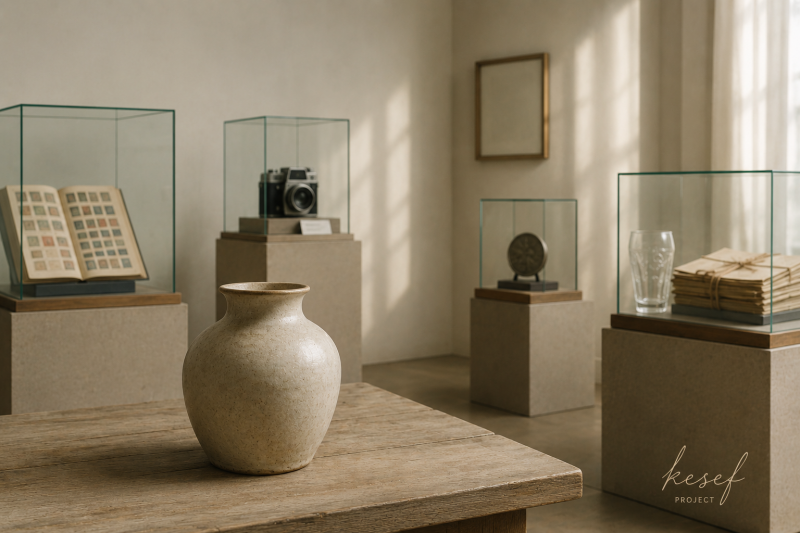

I've accumulated enough failures to fill an entire museum. I suspect I'm not the only one.
Some people collect coins, stamps, or those glasses Coca-Cola, Pepsi, and other brands used to release during Christmas promotions or World Cup seasons. Then there are the old sticker albums tucked away on a shelf, their pages yellowed with age and a few empty spaces that were never filled.
I've always found collections fascinating, not so much because of what they contain, but because of what they reveal about the people who keep them. Every collection tells a story, and some take up considerably more room than others. Maybe that's why I've always liked museums.
While most visitors stop in front of the famous pieces—the painting featured in textbooks, the sculpture that has survived for centuries, the masterpiece everyone photographs—I tend to wonder about what has been left out of the exhibition. What is stored in some back room because nobody quite knows what to do with it? What has been repaired so many times that it barely resembles its original form?
And yet, there it remains behind glass, accompanied by a small plaque attempting to summarize years of history in just a few lines.
Sometimes I think life works much the same way. We don't exactly collect objects; we collect experiences. Some arrive without being invited. Others result from decisions we make deliberately. A few continue occupying space long after they've ended, not necessarily because we want to remember them, but because we still don't know where they belong.
That's why the idea of a Museum of Failures feels strangely familiar to me. I wouldn't have much trouble filling it, and I doubt you would either.
I've always been drawn to restored pieces, especially those that never quite regained their original appearance. From a distance, they look intact. Come closer, and you notice the missing fragments, the replacement parts, and the cracks that couldn't be erased.
There is something honest about that kind of restoration. It doesn't pretend the damage never happened; it finds a way to preserve the piece despite it.
Restoration doesn't always mean returning something to what it was before.
Sometimes we have to accept that certain parts will never come back, that some cracks have become part of the story, and that a piece does not lose its value simply because it has lost its original form. The same idea applies to our lives, although it can be difficult to accept when what we're trying to restore is not an object, but a relationship, a dream, or a version of ourselves we believed would last forever.
Some relationships end after a single event changes everything. Others gradually wear down, almost without announcing that they're coming to an end. A photograph loses color over the years; a letter is folded so many times that the paper eventually begins to split along the creases. A dream that once seemed entirely possible becomes harder and harder to imagine until, one day, we realize we've stopped expecting it to come true.
There are also endings that need no extraordinary explanation. Something reaches its natural conclusion, and that's all. It doesn't have to mean it was a mistake or that it lacked value. Some things belong to a particular season of our lives and are meant to remain there, in a gallery called memory.
Accepting that possibility may also be part of restoration. Not everything that ends needs to be repaired, and not everything we lose has to be recovered. Sometimes the problem begins when we insist on returning to the exhibition a piece that has already been removed.
I think many of us spend more time than we'd like wandering through certain rooms of the past. We go back to look again, replay the conversation, reconsider the decision, and examine the ending from another angle. Perhaps we're hoping to find an explanation we missed at the time or discover what we could have done to prevent it.
But returning again and again doesn't guarantee that we'll find a different answer. Sometimes all we accomplish is keeping open a chapter we can no longer change.
For a long time, I thought my museum was made entirely of things that had happened to me: doors that closed, goodbyes, plans that failed, and opportunities that disappeared before I could decide what to do with them. It was easier to walk through those rooms because I could view the losses as things I had been forced to experience.
Until I discovered another gallery, one that was considerably harder to visit.
It contained the things I had broken myself.
There were wrong decisions, words I should never have said, people I had hurt, good things whose value I had failed to recognize, and situations I had held on to long after it was time to let them go.
That room changes the perspective. It is relatively easy to wonder why others left certain wounds in our stories. It is far more uncomfortable to acknowledge the consequences of our own decisions, especially when we can no longer go back and make things right.
Not everything that went wrong was our responsibility, but neither can everything be explained by what others did. Admitting both truths requires more honesty than choosing just one version of the story—the one in which we are always the people who were hurt and never the ones who caused the hurt.
A museum with a closed gallery cannot tell the whole story.
The same is true of us. If we preserve only the memories that help us explain our losses while avoiding those that force us to acknowledge our mistakes, our version of the past will be incomplete. And an incomplete story can become a convenient way to avoid taking responsibility.
Perhaps at some point we stop being visitors to our own museum and become its curators.
Someone has to decide what stays on display, what deserves restoration, what can be moved somewhere less prominent, and what has already served its purpose. A curator does not destroy a piece simply because its history is difficult. But neither does a curator necessarily place every object in the main gallery or require visitors to look at it over and over again.
Our history works much the same way. Some memories deserve to be kept close, some experiences still have something to teach us, and some mistakes need to be remembered so we don't repeat them. But preserving them does not mean giving them all the same space or allowing each one to remain at the center of our lives.
We can remember a betrayal without organizing every future relationship around distrust. We can acknowledge a wrong decision without making it the definitive explanation of who we are. We can even accept that something had value at the time, although it no longer has a place in our lives today.
This does not erase the consequences or free us from repairing the damage when that is still possible. Nor does it mean we must rush to find a positive side to every painful experience. Some losses still hurt, and the consequences of certain mistakes do not disappear simply because we've learned something from them. The question is whether, alongside acknowledging what happened, we are willing to decide what to do with it now.
Sometimes we keep certain memories on display because they help us explain who we are. Other times, we leave them there because we are still waiting for someone to acknowledge what they did to us, understand what we lost, or confirm that we were right. Until that confirmation comes, we return to the same room, as though our story needs a visitor's approval before it can finally be resolved.
But we will not always receive that response. Some people will never admit the harm they caused; certain questions will remain unanswered, and there will be endings we cannot fully understand. If our peace depends on getting an explanation from every person or bringing every chapter to a perfect close, we risk spending our lives waiting in front of a door that may never open.
Perhaps the real difficulty is not having a collection of failures. We all accumulate experiences that did not turn out as we expected, decisions we regret, and losses we still struggle to place. The difficulty lies in believing that honoring our history requires us to keep every piece permanently on display.
Not everything worth remembering needs to remain on display.
There are things we can preserve without continuing to feed resentment. Lessons we can carry with us without turning them into a constant warning. Experiences that remain part of our story without always having to occupy center stage.
Perhaps the museum was never the problem. We all have one. The question worth asking is what happens when we realize that keeping everything in plain sight is also a choice.
After all these years of walking through the halls of our own history, what are we choosing to display?
By Kesef Project