

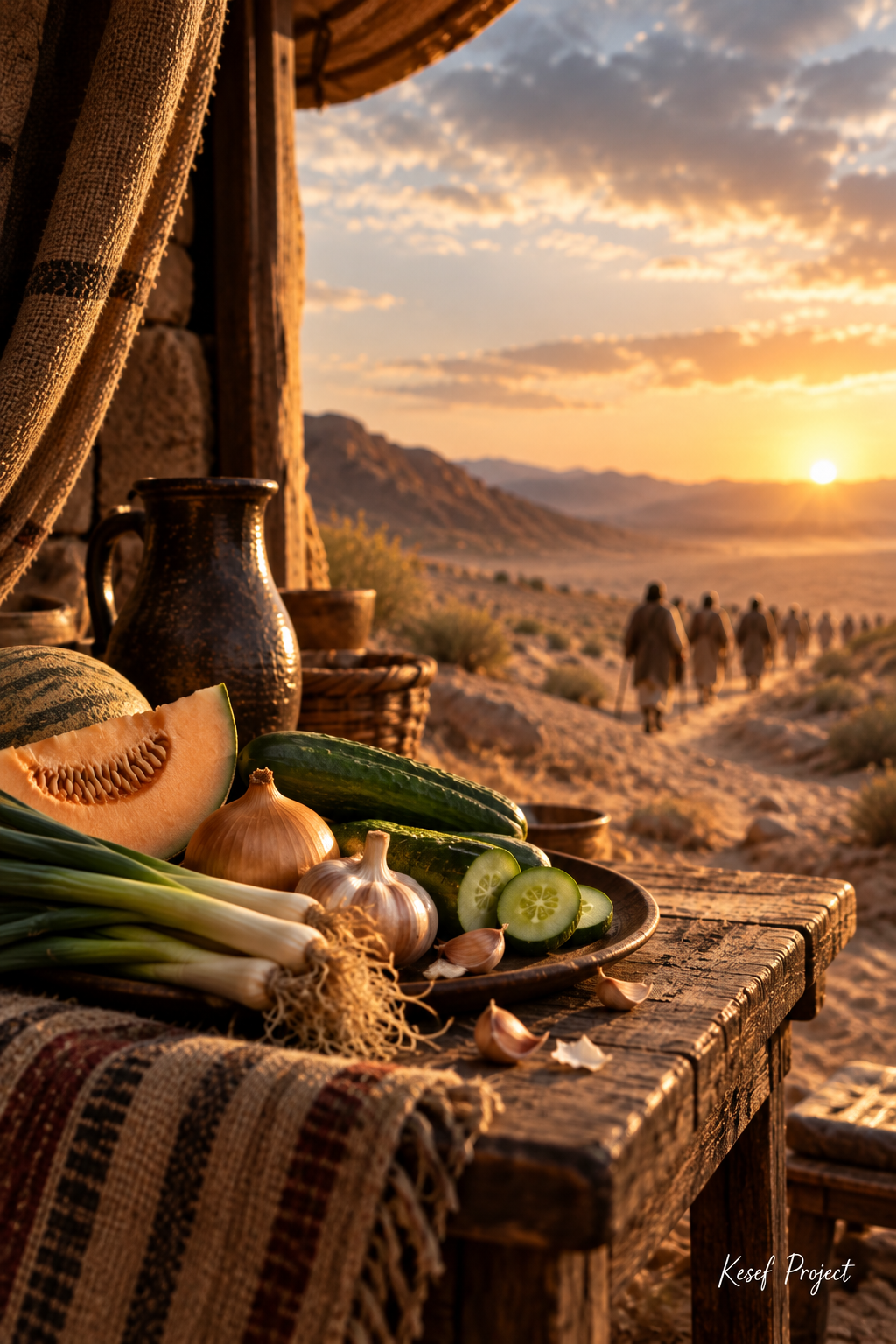

As the people of Israel traveled through the wilderness, they began remembering the food they used to eat in Egypt: cucumbers, melons, leeks, onions, and garlic (Numbers 11:5).
What stands out is that, while witnessing miracles every day—the manna that came down from heaven, the water that flowed from the rock, and God's presence guiding them—their thoughts kept returning to the taste of Egypt.
Memory rarely tells the whole story. It selects, softens, and distorts.
Egypt had been a land of slavery. Yet they remembered the food. They remembered what had been on the table, but seemed to have forgotten everything that happened around it: the forced labor, the oppression, and the life they had cried out to God to escape.
The wilderness, on the other hand, was a place of formation. There, they depended on God every day. Each morning required trust, and every step forward called for faith. They could not return to the old system and pick up their lives as though nothing had happened. They were learning to live differently, and that also meant learning to depend in a different way.
That was where the tension began.
Freedom requires trust. Familiarity requires nothing.
The problem was not the wilderness. It was where God was shaping a people. The difficulty was that many of them remained attached to the taste of Egypt. They had left that place, but they still carried parts of its way of thinking and understanding life.
Perhaps that is one of the hardest parts of any transformation. Leaving something behind does not automatically erase every attachment we have to it. We can enter a new season and still think according to the standards of the previous one. We can be grateful for our freedom and, at the same time, long for what we know. We can even recognize that something was harmful and still feel drawn to it because we knew how to function there.
Centuries later, Solomon would write:
“There is nothing new under the sun” (Ecclesiastes 1:9).
And the pattern is still recognizable. Even today, we can begin a process of transformation only to find ourselves remembering the “taste” of the life we left behind.
Not necessarily because it was better, but because it was familiar.
Sometimes, what we miss is not really the place itself, but how easily we knew how to function there. We knew the rules, the routines, and what to expect. Even if that life was not good for us, we understood how it worked. It may have been painful, but at least it was predictable.
Not everything you miss is meant for you.
The wilderness is unsettling because it demands change. It confronts us with what we still carry inside and calls us to depend on God in ways we may never have experienced before. Transformation takes away the security of what we know and asks us to trust while we learn to live differently.
But the taste of Egypt lingers.
It can remain in the way we think, in the habits we struggle to leave behind, and in the memories we romanticize when the present becomes difficult. Sometimes, moving forward means more than leaving a season behind. It means accepting that we cannot continue using everything we once considered normal as our measure of well-being.
God may be leading us toward something new while we keep comparing His provision with what we remember having before. And that comparison can prevent us from recognizing what He is already doing in our lives.
The Israelites had manna, water, and God's presence. Yet their thoughts returned to cucumbers, melons, leeks, onions, and garlic. The issue was not the vegetables themselves, but what they represented: a familiar life, a familiar system, and a familiar way of deciding what was good.
We can do the same. We can receive something new from God and still evaluate it by the standards of the life we left behind.
We can be free and still think like slaves. We can move forward while part of us continues to look back.
What once held you captive can still feel familiar.
There is a particular difficulty in any process of transformation: what we know can continue to feel safer than what we are still learning to live with.
That is why, when the present becomes bothersome, the past can take on an appearance it never fully had.
We remember what we liked, the routines we had mastered, and the things we knew how to handle. What caused us pain fades into the background, while what felt familiar takes up more and more space in our memories.
This does not mean that everything we left behind was bad or that we must reject our past to move forward. It means we need to look at it honestly, without allowing nostalgia to decide what is worth bringing back.
The people of Israel had reasons to remember Egypt, but those memories did not tell the whole story. The food was real, yes, but so was the slavery. Remembering one without acknowledging the other could make the life God had delivered them from seem more desirable than the road ahead.
Something similar can happen when God leads us through a season we do not yet understand. We can become so focused on what we have lost that we stop recognizing what we are receiving. We can measure the present by the standards of the past and conclude that things are worse, when in reality, we are still learning to live differently.
The question is not whether we will ever remember what we left behind. It is what we do with those memories when they surface.
Do they help us understand the road we have traveled, or do they begin to convince us that we should go back?
God was shaping His people in the wilderness, but they kept comparing that experience with what they knew of Egypt. The freedom before them required a kind of trust that their former life had not demanded in the same way.
Perhaps that is our struggle, too: accepting that moving forward with God may mean no longer measuring what is new by the habits, securities, and standards of what we have already left behind.
Because leaving a place is not enough if we still allow it to determine how we see our lives.
When God leads you through a process of transformation, are you learning to trust His provision, or are you still longing for the taste of Egypt?
Kesef Project