

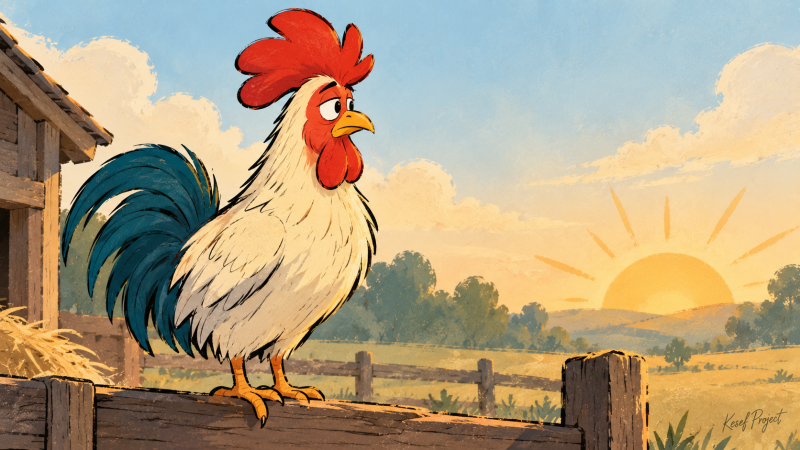
There are mornings when even a rooster seems to have his own existential problems.
Sky, the protagonist of a story I came across on Facebook, decided to skip his usual sunrise crow. The sun had risen, the hens were awake, and the crickets had already started their day. Everything was going according to plan, except for him.
When he finally came out of the coop, he seemed to have an explanation for his absence. The door timer was suspicious, the morning humidity might have played a part, the crickets may have disturbed his rest, and, for some reason, even the position of the sun became part of the investigation.
Apparently, the only suspect missing from the list was Sky himself.
The scene made me laugh. You don’t come across a rooster with such an impressive ability to present arguments in his own defense every day. But after laughing, I found myself thinking about something considerably less amusing: we are not exactly strangers to this behavior either.
We have an extraordinary ability to find explanations when things do not go as they should. Sometimes circumstances really do overwhelm us; other times, it is more comfortable to examine everything that happened around us than to stop and consider our own part in the matter.
The problem is not explaining what happened. It is using the explanation as a refuge, as though finding a sufficient reason automatically absolves us of the need to acknowledge our responsibility.
Yet not every morning is the same. There are days when we wake up full of energy, and others when simply opening our eyes feels like a considerable effort. The body responds, but our spirits seem to have remained somewhere in the night. Our responsibilities are still there, waiting, with little concern for how we feel inside.
Because there are people who don’t need to be reminded of their responsibilities. They have been carrying them since before they got out of bed. They show up, solve problems, take care of others, work, and keep going, even when nobody can imagine the effort it takes. Telling them that everything depends on their attitude would be as simplistic as blaming the sun for a rooster’s failure to crow.
Because there are people who don’t need to be reminded of their responsibilities. They have been carrying them since before they got out of bed. They show up, solve problems, take care of others, work, and keep going, even when nobody can imagine the effort it takes. Telling them that everything depends on their attitude would be as simplistic as blaming the sun for a rooster’s failure to crow.
But we can learn to recognize our own needs: to stop and regain our strength, ask for help if necessary, or admit that we are looking for another explanation to avoid facing what we are responsible for.
There is no contradiction between depending on God and taking responsibility for our actions. Nor is there a contradiction between acknowledging exhaustion and trying again once we have regained our strength.
What deserves closer examination is the habit of waiting for circumstances to be perfect before doing what is expected of us, as though life were obligated to accommodate our moods.
The sun did not change its position to help Sky. The next day, the rooster crowed again.
We cannot call every instance of exhaustion irresponsibility or turn every difficult day into a test of character. There are real limits, circumstances we did not choose, and seasons when we need to pause and regain our strength.
But there is also a difference between recognizing that we cannot handle everything and constructing an explanation to avoid examining what we are actually responsible for.
Recognizing the difference requires honesty. And honesty, curiously enough, is often far less comfortable than a good excuse.
Perhaps that is why admitting we have failed is so difficult. Explaining what happened allows us to preserve a certain image of ourselves; acknowledging our part forces us to look at something we would rather leave out of the picture.
At least Sky had the advantage of being a rooster. We have a much more elaborate repertoire of arguments.
And when our strength runs out, when the day feels heavier than usual and getting up seems beyond our own abilities, we also need to recognize that not everything depends on us. For those of us who believe in God, faith is not a guarantee that every morning will find us feeling strong. Sometimes, it is precisely what sustains us when we are not.
Some days we get up because we have responsibilities to fulfill. On others, because someone needs us. And there are mornings when, honestly, we can only thank God for allowing us to get up one more time.
We will not always have a different morning the next day. Some difficulties remain, certain burdens do not disappear, and some situations require more than a night of rest. But we can learn to distinguish between the times we need to stop, the moments when we should ask for help, and the occasions when we are simply looking for another explanation to avoid facing what lies before us.
Perhaps the real question was never why Sky failed to crow that morning. The more interesting question is what we do when we fail to meet our own responsibilities: do we examine what happened honestly, or do we look for someone to blame before acknowledging our part?
Even a rooster can have a difficult morning. We also have days when our strength runs low and simply getting up requires more effort than usual. We do not always need someone demanding more of us; sometimes we need rest, understanding, or God's grace to keep going. At other times, we need to stop making excuses and take responsibility for what is ours to carry.
The difference lies in learning to recognize what we truly need, without using our difficulties to evade responsibility or turning every stumble into a personal condemnation.